This article on Epainassist.com has been review by a medical professional , as well as check for facts , to assure the proofreader the best possible accuracy .
We follow a strict editorial policy and we have a zero - leeway policy regarding any level of plagiarism . Our article are resourced from reputable online pages . This article may contains scientific address . The number in the parentheses ( 1 , 2 , 3 ) are clickable links to peer - reviewed scientific papers .
The feedback link “ Was this Article Helpful ” on this Sir Frederick Handley Page can be used to cover message that is not accurate , up - to - date or questionable in any manner .

This clause does not provide medical advice .
Degenerative Disc Disease is a status where devolution of the intervertebral discs of the spinal column come . It is a condition which result from wearing and tear change of the discs of the spine and it can occur in any part of the spine.1Degenerative Disc Disease involving the spine of the neck opening is call as cervical disc disease . When it affect the mid - back , it ’s call thoracic disc disease . When degenerative magnetic disc disease involves the lumbar region , it is called lumbar disc disease .
Degenerative Disc Disease can be a very painful stipulation and can halter day - to - day action of multitude suffering from it . Degenerative Disc Disease is a spinal condition where the platter in the back have been damaged or have undergone degeneration . It is not really a disease but is a degenerative condition that produces pain from a damaged saucer . Degeneration of the discs is a instinctive part of aging and as the meter goes on , all people will expose degeneration in their discs , and however , not everyone originate symptoms as Degenerative Disc Disease change from person to person in its nature and severity .
The spine is plan such that the vertebra are “ stacked ” together to render a flexible support structure . The spine also protects the spinal corduroy along with its skittish tissue that extends from the head down to the spinal newspaper column from hurt . The disk are pads that do as “ cushions ” between each vertebral consistency . These Acts of the Apostles as impact absorber and help in minimizing the encroachment of movement on the spinal column . The saucer are structured with a key softer factor ( nucleus pulposus ) . Due to hurt or degeneration , this softer constituent may sometimes rupture or herniate through the surrounding out ring ( annulus fibrosus ) and irritate adjacent nervous tissue paper . Each of the vertebra is bond by ligaments and they beleaguer each of the saucer . As the disc deviant , the ligaments are injured and develop localized pain in the country .
Types of Degenerative Disc Disease
Cervical Degenerative Disc Disease
One of the common character of degenerative magnetic disc disease is cervical degenerative disc disease . This condition is a common cause of cervix nuisance . It is usually feel as stiff neck . However , many the great unwashed do n’t even know they have cervical degenerative disk disease.2They may only become aware of this condition when they are being examined for another wellness job or during routine medical exam . When the nerves in the cervical spine are stung , it lead to cervical radiculopathy which causes painful burning at the stake or tingling sensations in the weapon . wear out and split of cervical discs lead to retrogression of cervical thorn . A fall or a twisting wound to the phonograph recording outer space can induce degeneration of the cervical acantha . Symptoms of Cervical Degenerative Disc Disease are continuing neck pain in the neck , with annoyance shine to the head , shoulders , arms and hands , stiff or inflexible neck with numbness , tingle , weakness in the neck , arm , or shoulders along with headaches .
Thoracic Degenerative Disc Disease
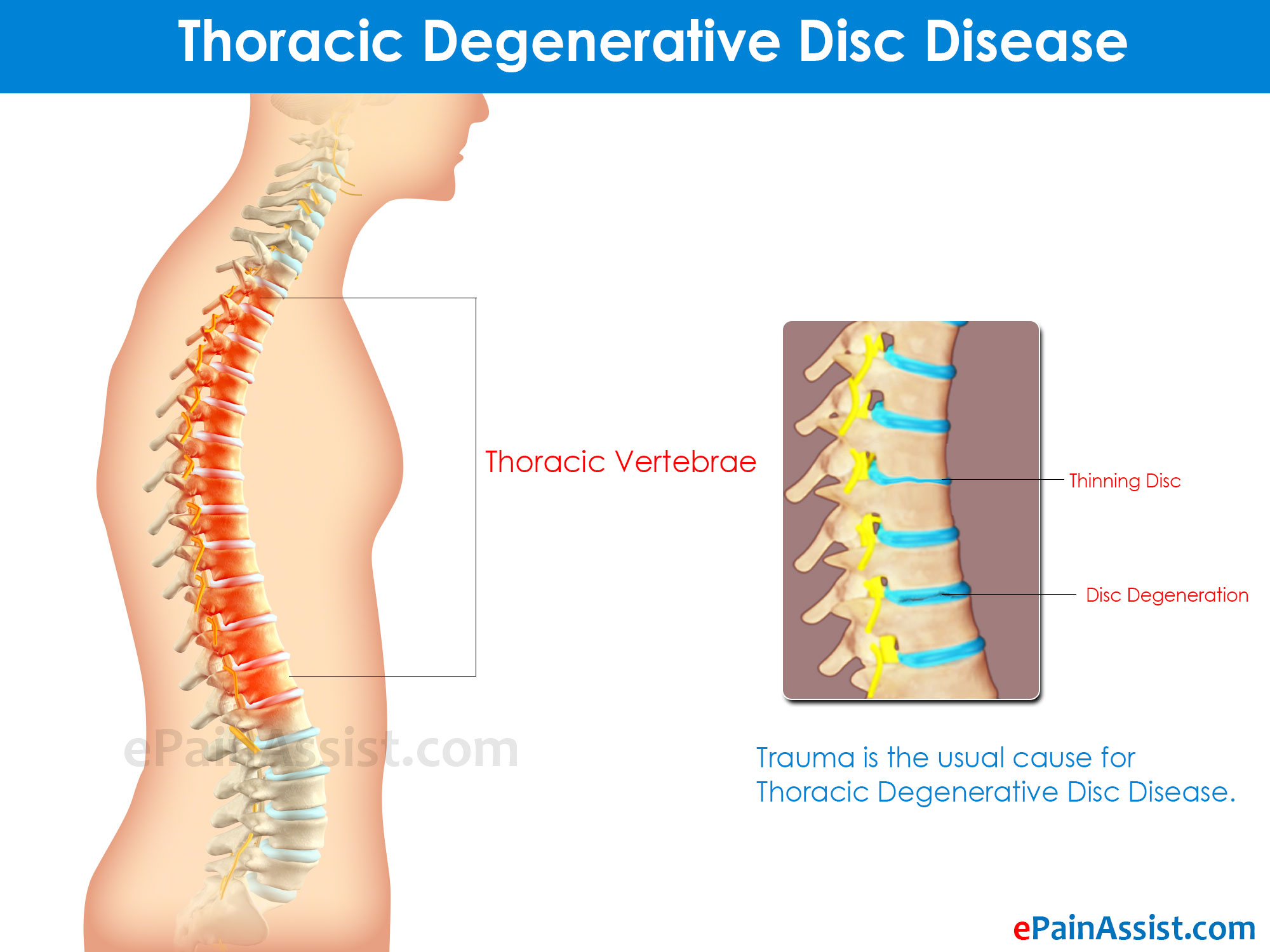
Thoracic Spine Degenerative Disc Disease occurs rarely when compared to other part of the spine . This is because the costa cage stabilizes the thoracic vertebrae , circumscribe cause and the resultant trauma from frequent flexing and bending . Trauma is the usual cause for this type of Degenerative Disc Disease in thoracic spine . Symptoms are infliction when twisting , muscle cramp , slumped posture , bowel or bladder dysfunction . It can be diagnosed by MRI , disco biscuit - ray , Discogram , CT scan , and Myelogram .
Lumbar Degenerative Disc Disease
This type of degenerative disc disease occurs after a torsional or twist trauma to the lower back ; however , wear and tear of the disk in the back also induce the pain.3Symptoms of lumbar degenerative disk disease are pain sensation in the lower back sometimes radiate to the hips and legs . Pain that is spoilt when sitting than standing , walk or even lying down and pain that is exacerbate by movement such as turn away , distortion or lifting .
Pathophysiology of Degenerative Disc Disease
Intervertebral platter can be differentiated by annulus fibrosus which is tenseness - resist and a nucleus pulposus , which is compression - refuse , formed mainly of proteoglycan . Annulus and nucleus provides mechanically skillful stability to the disc . Degenerative Disc Disease of lumbar spine is quite a serious wellness endangerment and take to be take seriously .
The intervertebral disc has three constituent . These are gelatinous nucleus pulposus , annulus fibrosus , and cartilage endplate . These are present in the superior and substandard portion . forbidden annulus fibrosus has abundance of type - I collagen . It is resistant to maximal stress because collagen fibers traverse obliquely between lamellae of annulus in freestanding directions . The nucleus pulposus is made of proteoglycan as well as water system gel , which are joined together lightly by an unorthodox internet of okay type - II collagen as well as Elastin fiber . Aggrecan is name given to the main proteoglycan of nucleus pulposus . This render osmotic properties require to tolerate compression . This disc is term as the biggest avascular tissue of the organic structure . vessel present in subchondral bone that adjoin hyaline cartilage in the motor end plate are creditworthy for furnish nutrition to disk tissue . Glucose as well as atomic number 8 , which are small corpuscle , passes through motor end plate as a result of a peaceful diffusion process . The cellular telephone present in disc ascendancy legion materials like cytokine , enzyme , growth factor thus preserve biological metabolism of saucer . Proteoglycan as well as collagen are produce by chondrocytes , the basic anatomical structure of disc . A molecule of proteoglycan is made up of protein center that is linked to extended polysaccharide chains , which are named Keratan Sulfate and Chondroitin Sulfate . Every atom is spring with hyaluronic acid via a inter-group communication protein . The most abundant proteoglycan in disc is Aggrecan and make up or so 75 % of nucleus pulposus with 25 % of annulus fibrosus .
The function of normal disc is to retain water within matrix direct to increase viscoelasticity . The Aggrecan generally has great osmotic pressure sensation due to water that is retained in nucleus pulposus and can inflate collagen model . Since nucleus pulposus is situated between vertebral endplates and the ring fibrosus , hence it is not able-bodied to thrive , but unquestionably has potential difference to expatiate . This is term turgor of nucleus pulposus . Normal disc tissue is able to support great burden without give because of gamy concentration of Aggrecan and this load is transferred equally between annulus fibrosus and the vertebral torso at time of flexion and extension of spine .

Several factors are responsible for for magnetic disk degeneration . There can be genetic predilection to it . pleomorphism loosely occurs in part of gene responsible for regulating production of MMP-3 . It is send for plugger region . The 5 - A allelomorph carry a risk of reform-minded degenerative changes of lumbar discs in elderly universe than kid . Growth factors like Transforming Growth Factor as well as Insulin Like Growth Factor among others facilitate chondrocytes and fibroblast into producing excess extracellular matrix along with restrain matrix metalloproteinases yield . Increase in level of Basic Fibroblast Growth Factor as well as Transforming Growth Factor facilitate repair of adulterated matrix . As mentioned , the prominent avascular tissue of organic structure is intervertebral disc . The cells present in center of lumbar disc in an adult are somewhere in the region of about 7 mm far from the cheeseparing blood supply . The blood watercraft in soft tissues around the outer boundary of out annulus and light incursion of capillaries in its outermost neighborhood allow victuals to cellular phone in the outer annulus . Poor nutriment of saucer is also consider to be one of the causes of saucer degeneration .
Degenerative phonograph record disease or disc degeneration is also related to age . Declining nutrition , electric cell aging , accrual of degraded intercellular substance products are mean to be other causes ; however , no distinct cause has ever been establish . The cells in halo decrease in concentration with age . The cellphone from magnetic disc also degenerate with age and lose their ability to grow . Degeneration is also race due to decrease constructive metabolism / increase katabolism of senescent cellular phone . Even though all magnetic disc are of same geezerhood , the discs in lower lumbar segments are more vulnerable for degenerative change when compared to upper lumbar segments . This indicates that mechanical loading can also be a major factor other than raw aging unconscious process .
Causes and Risk Factors of Degenerative Disc Disease
The main causal agency for degenerative magnetic disk disease is the wear and tear of the discs due to born ageing process in a human being . This gradual deterioration of the disc between the vertebrae is described as degenerative disc disease .
The age - interrelate changes that cause degenerative magnetic disk disease are : The loss of fluid in the spinal disc leads to reduced ability of the discs to represent as shock absorber absorbers and decreased flexibility . Loss of fluid also leads to cutting of the discs and nail down the distance between the vertebra . Other changes are the appearance of tiny tears or cracks in the extinct level ( annulus or abridgment ) of the disc . These cracks or tear cause the gelatinlike stuff present inside the disc ( nucleus ) to be forced out through the weeping or cracks in the capsule , causing the platter to bulge , break unresolved ( rupture ) , or fall apart into fragments . As the space between the vertebrae gets narrower , there is less padding between them and this decreases the stableness of the prickle . This leads to the formation of bony growths hollo as os spurs ( osteophyte ) . These bone spurs put pressure on the spinal nerve roots or the spinal corduroy cause pain and affecting the cheek role .
Other causes of degenerative disc disease let in trauma or hurt to the spine . An injury causes herniated disc and may begin the devolution appendage . Degenerative Disc Disease can also be caused due to hereditary gene .

Risk constituent for degenerative disk disease include the type of job of an individual ( e.g. lifting wakeless loads ) , bad lifestyle such as not eating healthy food for thought , not taking enough calcium , smoke cigarettes etc . , unfit position and lack of exercise .
Symptoms of Degenerative Disc Disease
degeneracy of the disc tissue makes the disk more susceptible to herniation . Degenerative platter disease may stimulate pain symptoms in the unnatural arena . As note before , any part of the spine can be affected by disc decadence .
Symptoms of Cervical Degenerative Disc Disease
When Degenerative Disc Disease affects the spine of the neck , it is hollo cervical disk disease . Symptoms of cervical degenerative disc disease includes inveterate cervix pain in the neck , with painfulness radiating to the head , shoulder , weaponry and hand . Stiff / sturdy cervix , numbness , tingle , weakness in the cervix , subdivision , or shoulders along with headaches are other symptoms of cervical degenerative disc disease .
Symptoms of Thoracic Degenerative Disc Disease
When the degenerative disc disease takes place in mid - back , it is name to as thoracic disc disease . Symptoms of Thoracic Degenerative Disc Disease are pain when twisting , muscle cramp , slumped position , bowel or bladder dysfunction .
Symptoms of Lumbar Degenerative Disc Disease
Symptoms of Degenerative Disc Disease in the lumbar backbone includes chronic low back painful sensation referred to as lumbago or may cause spinal face irritation leading to hurting shine down the leg ( sciatica ) . Lumbago also make symptoms of painful sensation localized to the humble back and is coarse in honest-to-god people . The humiliated back hurting caused due to degenerative disk disease is usually made worse with posing , because in the session position the lumbosacral discs are burdened three metre more than while standing . inveterate depressed back pain in the neck may also glow to hips . There may be pain in the buns or second joint during any activity .
symptom of lumbar degenerative disc disease also includes tingle or helplessness in the genu and ramification . The painful sensation is also feel or increases upon any cause such as sitting , bending , lifting , and distortion . Prolonged sitting or standing increases the pain more . Patients usually feel comfortably when they change their positions . The pain peculiarly is at minimum when the affected role is lying down , as this relieves stress on the platter distance .
Symptoms of lumbar degenerative disc disease also includes pain sensation / irritation in lower back , stiffness in lower back , burn genius , tingling and numbness in the buttocks and lower back down to the legs .

Other Common Symptoms of Degenerative Disc Disease
Degenerative Disc Disease also makes the platter more prone to herniation . Degenerative phonograph recording disease leading to hernia causes spunk irritation have-to doe with to as radiculopathy . When the cervix share is affected , it is called cervical radiculopathy lead to painful burning or tingling sensations in the arms . When the mettle in the back portion are affected , it is telephone as lumbar radiculopathy . This unremarkably causes “ sciatica , ” a pain that shoots down towards lower extremities accompanied by apathy and tingling sensation . The pain increases with cause and in more acute cases causes dissoluteness of the bladder and/or gut .
Treatment for Degenerative Disc Disease
Most of the time , Degenerative Disc Disease can be successfully treated with conservative discussion consisting of medicine to control rubor and pain with physical therapy and use . If the patients have not achieved relief in over six calendar month of bourgeois treatment and Degenerative Disc Disease is significantly affecting the patient role ’s ability in performing everyday activities , only then operation is considered .
Treatment for Cervical Degenerative Disc Disease
If the pain in the ass cause due to cervical degenerative saucer disease is not remedy within six month of non - surgical care , then fusion is recommended to stop the motion of the affected cervical section of the backbone .
Treatment for Thoracic Degenerative Disc Disease
If the non - surgical methods are not effective in treating symptoms of thoracic degenerative disc disease then a operative procedure call discectomy is considered as a last refuge . This involves bump off the disc or the bulged area that is agitate on the neural tissues . unstableness result from get rid of the disc and therefore the pearl may need to be meld . This requires off-white transplant into the intervertebral space and metal hardware to guard the bones together .
Treatment for Lumbar Degenerative Disc Disease
If the pain caused due to lumbar degenerative disk disease is severe and go forward even after six months of all-embracing non - surgical forethought then lumbar spinal fusion surgery is recommended . The most coarse type of fusion is a one - level spinal fusion at the L5 - S1 segment and this does not affect the movement of the back . Whereas a fusion at the L4 - L5 section remove some of the normal motion as this is a major section of the lower back . Multi - level fusions increase the risks .
Another surgical discussion choice for lumbar degenerative disc disease is artificial disk replacement . In this method the disc is replaced instead of fuse the disc space together . Normal growth in the lumbar spine is more maintain in this method of treatment .
Investigations Done to Diagnose Degenerative Disc Disease
References :
Also understand :
