This article on Epainassist.com has been reviewed by a aesculapian professional , as well as checked for fact , to control the reader the well potential accuracy .
We follow a strict editorial policy and we have a zero - tolerance policy regarding any grade of plagiarization . Our article are resourced from reputable on-line Page . This article may contains scientific references . The number in the parentheses ( 1 , 2 , 3 ) are clickable connectedness to equal - brush up scientific papers .
The feedback link “ Was this Article Helpful ” on this Thomas Nelson Page can be used to cover message that is not accurate , up - to - escort or questionable in any manner .
This article does not provide medical advice .
What Is Spinal Shock?
Spinal shock is a rare aesculapian condition occurring as a result of a spinal cord combat injury and is characterized by loss of feeling or sentience with motor palsy . Patient suffering from spinal cushion also has deprivation of reflexes in the beginning , but it is play along by gradual recovery of the reflexes . Spinal stupor is a compounding of autonomic and motor dysreflexia.1Motor dysreflexia is presented in four phase as areflexia ( loss of reflex action ) , hyporeflexia ( slow lethargic reflex ) , normal reflexes and hyper ( exaggerated ) reflexes.1Spinal jounce comprises of a period of absent motor reflexes , which can be temporary or permanent , followed by another period of unreasonable reflex action or hyperreflexia .
Spinal blow is dissimilar fromneurogenic shock . There is no circulatory collapse in spinal shock . Neurogenic shock is triggered by stark autonomic disfunction or dysreflexia resulting in grievous vasodilatation and heart malfunction.2Neurogenic shock may not be associated with areflexia . Spinal shock does make minor transeunt autonomic dysfunction . affected role enters spinal electric shock within a few minutes after thespinal electric cord wound ; however , it can take many hours for the full effects of the spinal impact to occur . When in spinal shock , the nervous system lose its ability of transmitting signals ; but there is gradual take of them after the spinal shock has started to settle . The duration of spinal shock can be anywhere from 4 to 6 weeks after the injury . Rarely , spinal jar can last for some months . The absence seizure of reflexes or signals handicap the patient ’s power to move , power to sense and other functions . Patient often has complete loss of sensation and social movement below the level of spinal cord injury . This can conceal the actual extent of the price . Spinal seismic disturbance patient commonly has gradual proceeds of the reflexes and betterment in the trunk ’s function after the electric shock start to recede . At this stage , it is unmanageable to predict the time and extent of recovery or add up to any conclusion regarding palsy .
What Happens To The Patient In The Different Stages of Spinal Shock?
leg 1 of Spinal Shock : In this stage , there is weakening or complete loss of all reflexes below the level of spinal cord injury . This phase go for a day .
microscope stage 2 of Spinal shock absorber : This stage pass over the next two days and there is gradual recurrence of some of the inborn reflex below the spinal cord injury .
Stage 3 & 4 of Spinal electrical shock : In this phase , affected role has abnormally strong or increased reflexes ( hyperreflexia ) , which are produce with minimal stimulation .

What Are The Causes of Spinal Shock?
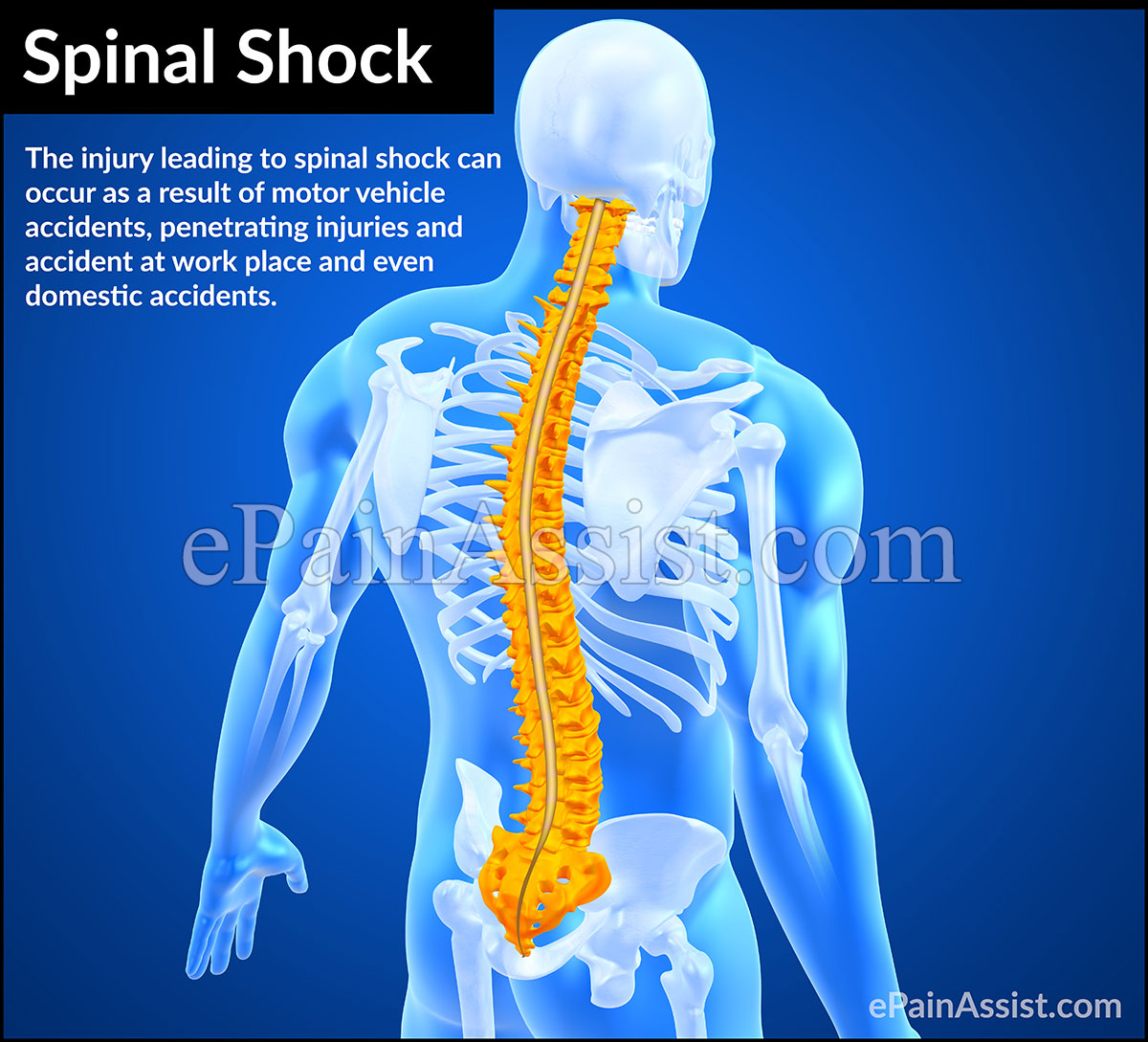
As mentioned before , spinal shock come following injury ortraumato the spinal cord . The injury leading to spinal shock can occur as a effect ofmotor fomite accidents , riddle injuries and accident at body of work station and even domestic accidents .
Spinal electric cord trauma causes sensory , motor and autonomic nerve impairment . Spinal shock or Spinal cord shock is a compounding of autonomic and motor dysreflexia .
About Dysreflexia-
About Autonomic Nervous System
The autonomic unquiet organisation is divided in sympathetic and parasympathetic nerves .
Sympathetic nerves lie in spinal cord .
The parasympathetic nerve originates in brain and sacral face .
Parasympathetic Hyperactivity-
Symptoms and Signs of Spinal Shock
Symptoms and Signs of Spinal Shock Based on the Level of Spinal Cord Injury-
Prognosis of Autonomic Dysreflexia in Spinal Cord Injury Resulting in Spinal Shock-
Abnormal Findings
Skin Lesions-
Cardiovascular System-6
Four Recovery Phase of Motor Dysreflexia-7
The characteristics of bubocavernous and deep tendon reflex during recovery phase changes . Accordingly the recovery phase is separate in four phases as follows-
Investigations For Spinal Shock
Treatment of Spinal Shock or Spinal Cord Shock8
Spinal Cord Treatment depends on the injury sustained .
bear on intravenous fluid and volume injected as necessary to maintain normal lineage press .
Medications For Spinal Shock
steroid are given after the spinal corduroy injury to deoxidise inflammation and to preclude further nerve damage .
It is vital to keep further boldness damage , therefore , steroid hormone , such as methylprednisolone are given straightaway upon arrival to the hospital and should be given preferably within 8 hours of accidental injury to prevent and reduce nerve damage .
Medications such as dopamine , epinephrin , are given for super downcast blood pressure level .
These medications are know as vasopressor
Antibiotics are given to prevent sepsis .
line transfusion is demand in case of grave blood loss , as is seen in motor vehicle accident .
Surgery For Spinal Shock or Spinal Cord Shock
Also Read :
character reference :
1 . Early autonomic dysreflexia .
Silver JR , Spinal Cord . 2000;38:229 - 233 .
2 . Cardiovascular control condition after spinal cord hurt .
Gondim FA1 , Lopes AC Jr , Oliveira GR , Rodrigues CL , Leal PR , Santos AA , Rola FH .
Curr Vasc Pharmacol . 2004 Jan;2(1):71 - 9 .
3 . Cardiac dysfunctions following spinal corduroy hurt .
Grigorean VT1 , Sandu AM , Popescu M , Iacobini MA , Stoian R , Neascu C , Strambu V , Popa F.
J Med Life . 2010 Jul - Sep;3(3):275 - 85 .
4 . Vascular disfunction following spinal corduroy wound .
Popa C1 , Popa F , Grigorean VT , Onose G , Sandu AM , Popescu M , Burnei G , Strambu V , Sinescu C.
J Med Life . 2009 Apr - Jun;2(2):133 - 45 .
5 . Cardiovascular and urological dysfunction in spinal cord injury .
Hagen EM1 , Faerestrand S , Hoff JM , Rekand T , Gronning M.
Acta Neurol Scand Suppl . 2011;(191):71 - 8 . doi : 10.1111 / j.1600 - 0404.2011.01547.x .
6 . Disordered cardiovascular control after spinal cord injury .
Weaver LC1 , Fleming JC , Mathias CJ , Krassioukov AV .
Handb Clin Neurol . 2012;109:213 - 33 . doi : 10.1016 / B978 - 0 - 444 - 52137 - 8.00013 - 9 .
7 . Spinal shock revisited : a four - phase model .
Spinal Cord . 2004;42:383 - 395 .
Ditunno JF , Little JW , Tessler A , et al
8 . Acute management of the patient with spinal cord harm .
Karlet MC .
Int J Trauma Nurs . 2001 Apr - Jun;7(2):43 - 8 .
